Building a Medallion Lakehouse on Azure Databricks: An Enterprise Blueprint
Most enterprise data platforms don't fail for lack of tools. They fail because the business stops trusting the numbers. Dashboards disagree, pipelines break quietly, and every new use case becomes a one-off project. The medallion architecture on Azure Databricks is a proven way to reverse that, but only when it's implemented with clear contracts, governance, and operating discipline. This blueprint distills what we apply on real enterprise engagements.
Why the medallion pattern still wins
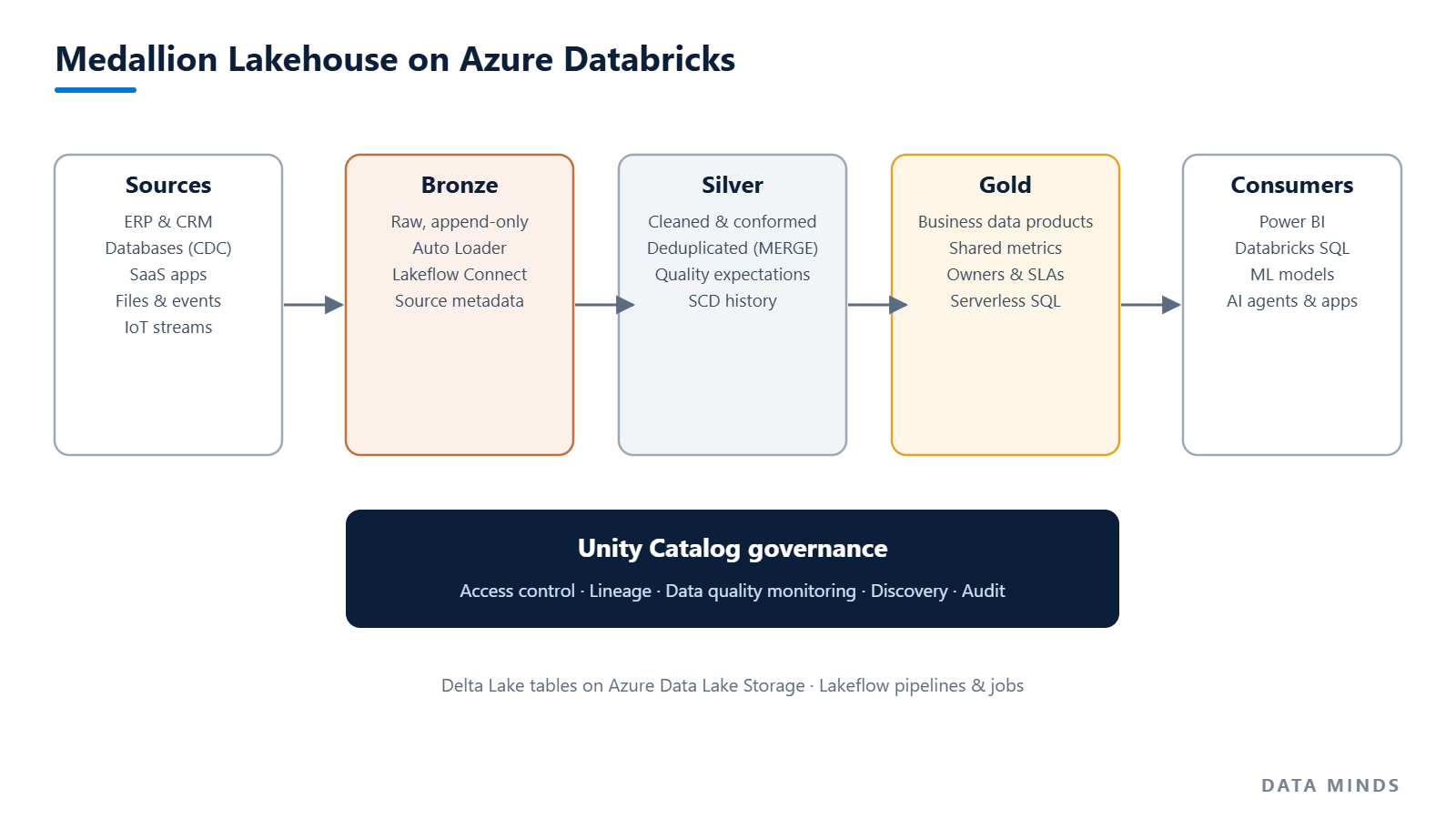
The idea is simple: data moves through three progressively refined layers. Bronze holds raw data exactly as it arrived. Silver holds cleaned, conformed, and deduplicated data. Gold holds business-ready data products shaped around real questions. Each layer has one job, which makes the platform easier to reason about, test, and govern.
What makes the pattern powerful on Azure Databricks is that every layer is stored as Delta Lake tables in Azure Data Lake Storage, governed centrally by Unity Catalog, and processed by the same engine. You get ACID transactions, time travel, schema enforcement, and lineage across the whole flow, without copying data between separate systems.
Bronze: land everything, change nothing
Bronze is your system of record for raw data. Its only goal is to capture what the source sent, completely and reliably, so you can always replay history.
- Ingest files incrementally with Auto Loader, which tracks what has already been processed and handles schema evolution without custom bookkeeping.
- Use Lakeflow Connect managed connectors for common SaaS and database sources where they fit, instead of maintaining hand-built extraction code.
- Add technical metadata to every record: ingestion timestamp, source system, file name or offset, and batch identifier.
- Keep bronze append-only. Resist the temptation to fix data here; fixes belong in silver where they are visible and testable.
- Rescue malformed records into a dedicated column or quarantine table rather than failing the whole load.
Silver: clean, conform, and deduplicate
Silver is where raw data becomes trustworthy. This is the layer most teams underinvest in, and it is the layer that determines whether the platform scales.
- Enforce data types, standardize units and time zones, and apply consistent naming conventions.
- Deduplicate using business keys and handle late-arriving and changed records with MERGE or change data capture (CDC) flows.
- Conform entities across systems, for example a single customer record built from CRM, billing, and support sources.
- Declare data quality expectations in Lakeflow Spark Declarative Pipelines so bad records are dropped, quarantined, or flagged, and the results are visible in pipeline metrics.
- Track history where the business needs it using slowly changing dimension (SCD) Type 2 patterns.
Gold: model data products for the business
Gold tables exist to answer questions. Build them around business domains and consumers, not around source systems. A well-designed gold layer is small, well documented, and stable.
- Model subject areas such as revenue, customer, supply chain, or risk with clear grain and ownership.
- Define shared business metrics once, for example with Unity Catalog metric views, so Power BI, Databricks SQL, and AI applications all use the same definitions.
- Serve BI through serverless SQL warehouses and connect Power BI with Import or DirectQuery depending on data volume and freshness needs.
- Publish gold tables as data products with an owner, description, freshness target, and quality SLA.
Govern once with Unity Catalog
Governance is not a separate project; it is part of the architecture. Unity Catalog gives you one place to manage access, discover data, and audit usage across bronze, silver, and gold.
- Organize catalogs by environment or business domain and schemas by layer, for example sales_prod.bronze, sales_prod.silver, sales_prod.gold.
- Grant access to groups, never individuals, and follow least privilege: most analysts should only see gold.
- Use row filters and column masks for sensitive data such as PII instead of maintaining duplicate secured copies.
- Rely on automatic lineage to answer 'where did this number come from?' and to assess the impact of upstream changes before you make them.
- Tag tables and columns with classification and ownership so audits and access reviews take hours, not weeks.
Performance and cost from day one
A lakehouse that is correct but slow or expensive will not survive its first budget review. Build efficiency in from the start rather than tuning after complaints.
- Use liquid clustering on large tables instead of hand-tuned partitioning, and let predictive optimization handle maintenance such as OPTIMIZE and VACUUM.
- Prefer serverless compute for jobs, pipelines, and SQL where it fits, so you pay for work done rather than idle clusters.
- Process incrementally. Recomputing full history every night is the most common source of wasted spend.
- Tag every job and warehouse with cost center and project, and review usage dashboards monthly with business owners.
Batch, streaming, or both
The medallion pattern works for both batch and streaming, and the same Delta tables can serve both. Choose per data product based on how fresh the business actually needs the data to be, not on what sounds modern.
- Daily or hourly batch is right for finance reporting, planning, and most BI. It is cheaper and simpler to operate.
- Near-real-time streaming with Structured Streaming or declarative pipelines in continuous mode is right for fraud signals, operational monitoring, inventory, and customer-facing experiences.
- Design silver so it can be processed incrementally either way. Moving a data product from hourly batch to streaming should be a configuration change, not a rewrite.
Roles and operating model
Technology alone does not keep a lakehouse healthy. Define who owns what before the first production pipeline goes live.
- Platform team: owns workspaces, Unity Catalog, networking, security baselines, CI/CD templates, and cost guardrails.
- Domain data engineers: own bronze-to-gold pipelines and data quality for their business domain.
- Data product owners: business-side owners accountable for definitions, priorities, and sign-off on gold tables.
- Data stewards: maintain classifications, access policies, and documentation.
This federated model lets domains move quickly on a shared, governed foundation, which is the practical middle ground between a central bottleneck and ungoverned self-service.
How to measure success
Track a small set of indicators that business and technology leaders both understand:
- Freshness SLA attainment for critical gold tables.
- Number of data quality incidents reaching business users per month, trending down.
- Time to deliver a new data product, from request to production.
- Adoption: active users and queries against gold tables and certified datasets.
- Cost per data product and per thousand queries, trending flat or down as usage grows.
Common pitfalls we see
- Treating bronze as a cleanup zone. Once you mutate raw data, you lose the ability to replay and audit.
- Building gold tables per report. This recreates the report sprawl the lakehouse was meant to eliminate.
- Skipping data contracts with source teams, so schema changes break pipelines without warning.
- Granting broad workspace-level access early 'to move fast', then spending months unwinding it.
- Measuring success by tables migrated instead of business decisions supported.
A pragmatic 90-day roadmap
- Days 1 to 30: set up the foundation. Unity Catalog metastore, catalogs and naming standards, networking and identity, CI/CD with Declarative Automation Bundles, and one bronze-to-silver pipeline end to end.
- Days 31 to 60: deliver the first data product. Pick one high-value domain, build gold tables with agreed metric definitions, and connect Power BI. Validate the numbers with business owners line by line.
- Days 61 to 90: operationalize. Add data quality monitoring and alerts, cost dashboards, runbooks, and a repeatable template so the next domain takes weeks, not months.
The takeaway
The medallion architecture is not about three folders of tables. It is an operating model: raw data you can always replay, clean data you can trust, and business data products with clear owners. Start with one domain, prove the numbers, and scale with templates and governance baked in. That is how a lakehouse becomes the foundation for analytics and AI rather than another data swamp.
Planning a lakehouse on Azure Databricks or modernizing an existing one? Data Minds helps enterprises design, build, and operationalize medallion architectures end to end. Reach out through our contact page to start the conversation.
Planning a data or AI initiative like this? Talk to the engineers who build it.
More Insights